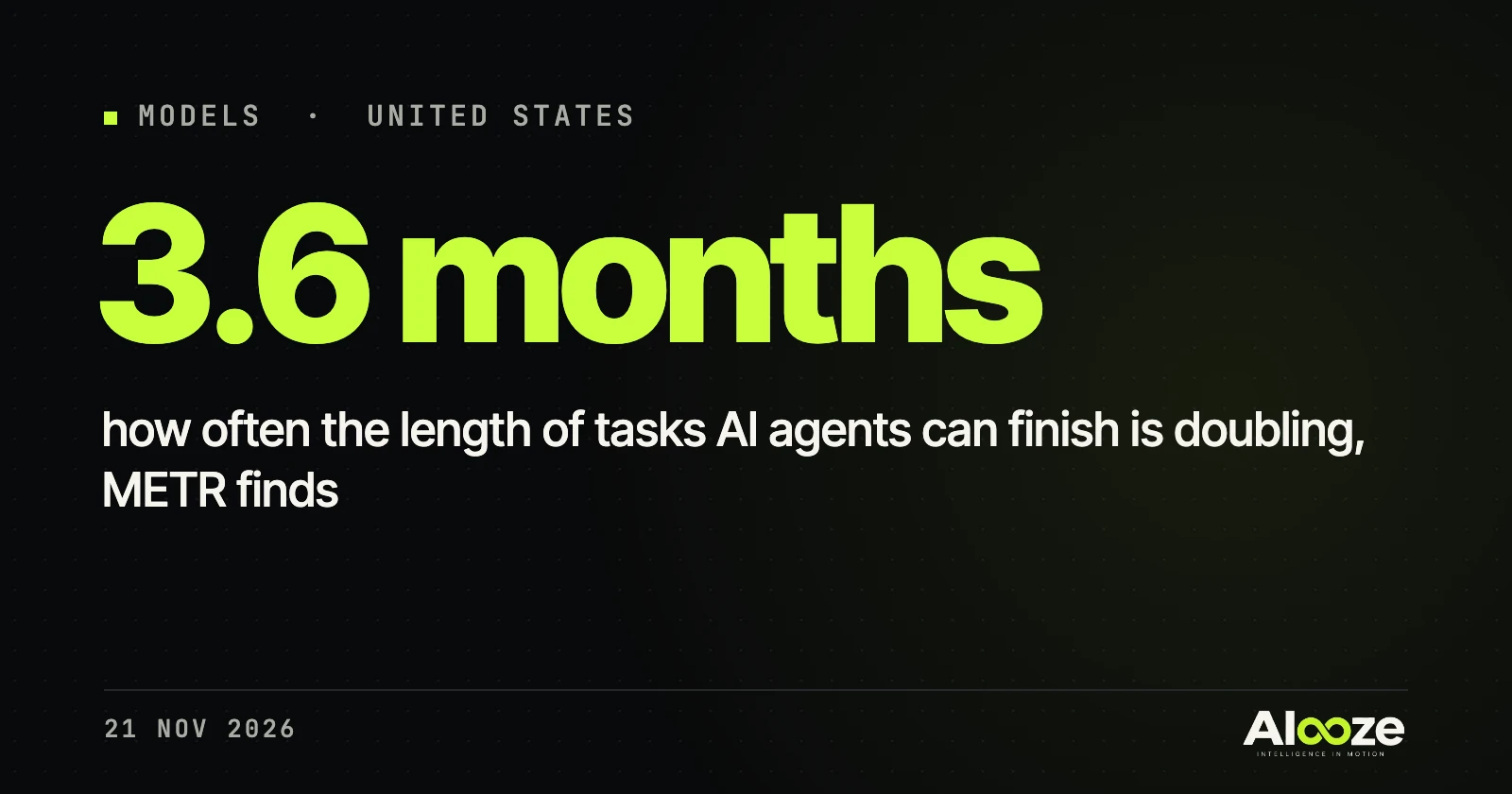
The length of software tasks that AI agents can complete on their own is doubling roughly every 3.6 months, according to a capability update published on 20 November by METR, a non-profit that evaluates AI models. METR measures a “time horizon”: roughly, how long a task would take a skilled human, for tasks an agent can finish at least half the time.
The update covers public models up to Anthropic’s Opus 5.5 and OpenAI’s GPT-6 Astra. METR says “models usually match or outperform skilled humans on our coding and optimization tasks”, and that its own human testers typically could not beat the best models. Current frontier models reach an estimated time horizon of “up to 27 hours” on one subset of its tasks. But agents “appear to have worse judgment than human experts” on tasks without clear feedback.
METR says it does “not see strong acceleration or deceleration” in progress, yet “current public evidence is insufficient to rule out drastic AI R&D acceleration in the next couple of years.”
this is one of the few outside measures of how fast AI agents are gaining the ability to do long stretches of skilled work, including work on AI itself. METR is open about the limits, saying it is “unsure of the validity of these findings due to their sensitivity to methodological choices.” Earlier this month METR also assessed AI R&D acceleration at one frontier lab.